Make strategy clear, execution daily, and impact visible.
Your organization may already know what matters. The harder part is making it shape the choices, conversations, decisions, and work that happen every day.
Strategic Learning Consultants helps organizations turn important priorities into clear choices, practical plays, working rhythms, and visible proof—so strategy does not stay in the plan. It moves through the work.
You may already know what matters. Yet the work still gets stuck.
The strategy has been presented. Priorities have been announced. Managers have attended meetings. Supervisors have joined training. Teams are busy.
And yet some of the work that matters most still moves too slowly.
A manager understands the priority but keeps making the same decisions as before. A supervisor delegates a task, then takes it back when the employee struggles. A meeting ends with agreement, but no one is quite sure who owns the next move. People know they should act with greater initiative, yet the safest response is still to wait for approval.
Sometimes the problem is not that people do not care. Sometimes they are working inside routines, measures, habits, permissions, and management practices that keep producing the same behavior.
That is why we do not begin by asking, “What training should we run?”
We first look at what matters, what keeps happening, and what is preventing the work from moving.
The blockage usually appears in a few recognizable places. Seeing where it sits gives us a much better starting point than choosing an intervention too early.
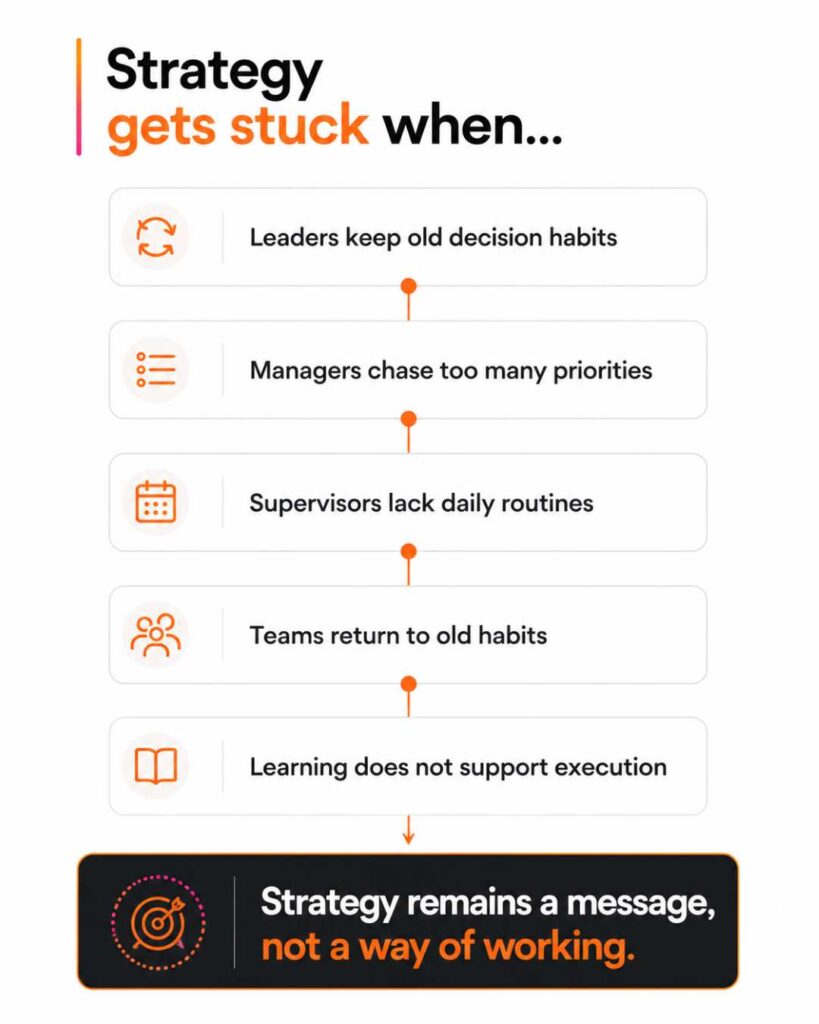
The real question is not “What training do people need?”
The real question is “What must change in daily behavior?”
Where is the work getting stuck?
Strategy rarely gets stuck in only one place. Sometimes the choices are unclear. Sometimes leaders understand the message but daily work still looks the same. Sometimes people know what matters but do not have a practical way to act on it.
Strategic Learning Consultants works through five connected paths. Start with the one that looks most like your situation.
Make Strategy Clear
When the plan contains many priorities but people still cannot see the choices, trade-offs, focus, or decision rules.
We help leadership teams clarify what matters, where to focus, how they intend to win, what must receive less attention, and what those choices should change in daily decisions.
Build Leaders Who Move Work
When leaders understand the strategy, but direction, delegation, decisions, meetings, coaching, and follow-through keep creating delay, dependence, or confusion.
We help executives, managers, and supervisors translate what matters into the way they lead the work every day.
Explore Leadership That Moves Work →
Make Execution Daily
When people know the priority but the expected behavior remains too broad to use under pressure.
We help teams locate the critical moments where strategy must show up, turn important choices into practical plays, build them into everyday rhythms, and watch what happens when people use them.
Explore Make Execution Daily →
Run Strategy Workshops That Move Work
When people need to confront a trade-off, resolve disagreement, make a shared decision, design something together, or move an important piece of work.
We design workshops around what the room must produce—not around activities that merely fill the agenda.
Build Learning Systems and Proof
When people learn something useful but the old behavior returns once the program ends.
We help organizations connect learning with real-work practice, manager support, routines, tools, working conditions, and evidence—so they can see what is being used, what is moving, and what deserves the next investment.
Explore Learning Systems and Proof →
These paths are connected. A strategy problem can become a leadership problem. A leadership behavior can fail because the surrounding system rewards the old response. A workshop can create agreement and still fail if nobody designs what happens next.
Start where the work is stuck. Then follow the movement.
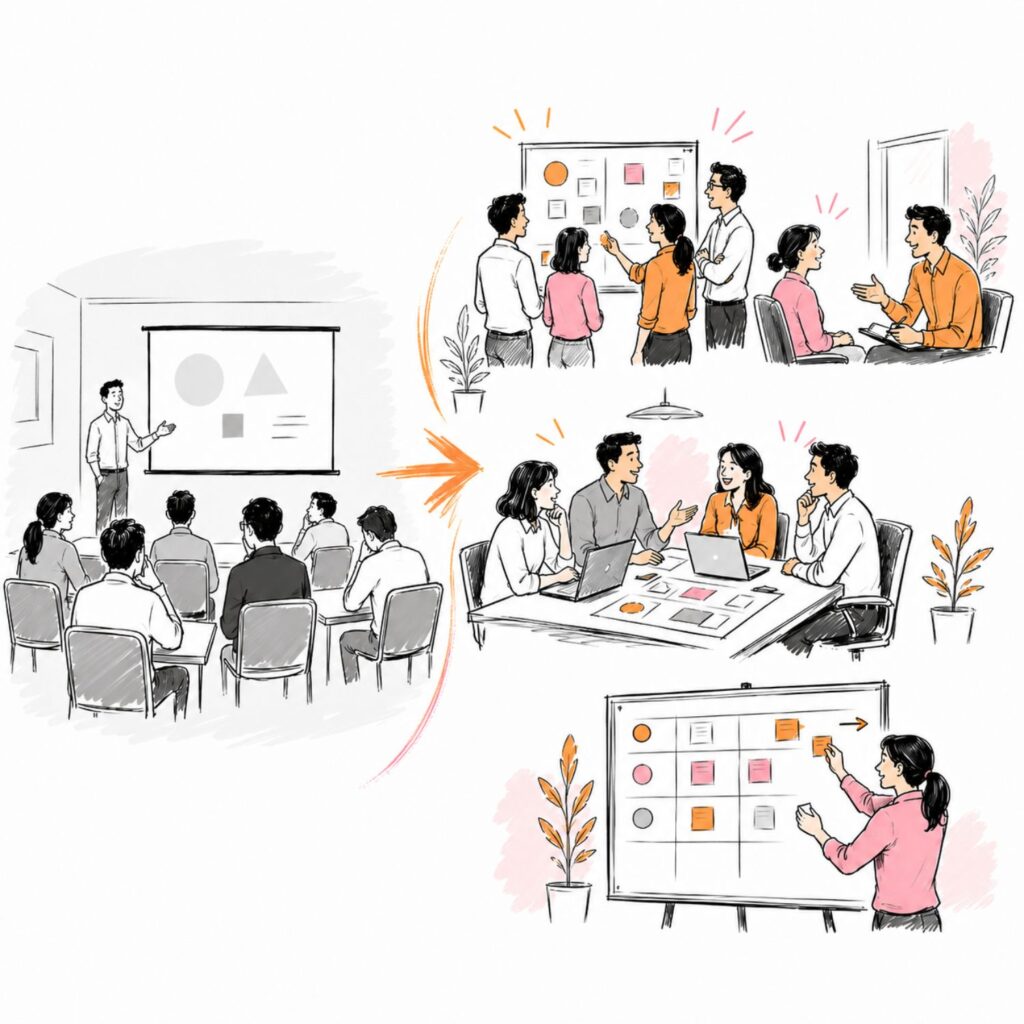
See Strategic Learning in the work
A supervisor gives Carlo an urgent assignment.
“Finish this as soon as possible.”
Carlo starts. A few minutes later, he comes back with a question. The supervisor explains more. Carlo returns again. More instructions follow.
Eventually, the supervisor begins doing part of the work himself.
Nothing about this response seems unreasonable. The deadline is close. Carlo is uncertain. Explaining more feels like the fastest way forward.
But the activity keeps increasing while the work remains dependent on the supervisor.
More instructions can create more dependence
When an employee seems uncertain, giving more instructions feels helpful.
Sometimes it is. But if Carlo still does not know what successful completion looks like, every new explanation may simply give him another reason to return.
The supervisor becomes clearer about the steps. Carlo does not necessarily become clearer about how to move.
Clear direction should help someone act
The test of direction is not how much the supervisor said.
The better question is: What can Carlo now do without coming back?
That changes the conversation. Instead of trying to explain everything, the supervisor can give Carlo enough clarity to move.
Give people something they can move with
Before Carlo leaves, the supervisor can clarify four things.
The win. What must be true when the work is finished?
The boundaries. What can Carlo decide on his own, and what requires approval?
The first move. What should he do next?
The checkback. When should they reconnect, and what should Carlo bring back?
Now the supervisor is not merely transferring instructions. He is making responsible independence more possible.
Look for less dependence in the work
The real test does not happen when Carlo can repeat the four questions.
It happens during the next few assignments.
Are there fewer avoidable clarifying calls?
Does Carlo make more decisions within the agreed boundaries?
Is there less work returning for revision?
Do checkbacks happen when they are supposed to?
If those things begin to change, we have evidence that the new response is entering the work.
If they do not, we have learned something equally useful: the blockage may be somewhere else.
This is Strategic Learning in practice. Something matters. We find the moment where it gets stuck, change what happens there, watch what moves, and use the evidence to decide what to do next.
Four connected systems. Start where the work needs to move.
Organizations do not always get stuck in the same place.
One leadership team needs to make sharper strategic choices. Another already has a strategy but needs managers to carry those choices into daily decisions. Another needs supervisors to change what happens at the frontline. Another needs learning experiences that help a different response survive after the workshop.
These four systems connect that work.

Play to Win
Make the choices that give the organization direction.
Play to Win helps leadership teams clarify what winning means, choose where to play and how to win, make trade-offs visible, identify the capabilities the strategy requires, and build the management systems that keep those choices alive.
The result is not simply a completed strategic plan. The strategy becomes usable enough to guide what receives attention, what receives resources, what gets postponed, and what leaders decide differently..

Leader’s Game
Turn strategic choices into the way leaders lead the work.
A strategy can be clear in the leadership room and still disappear inside meetings, decisions, delegation, coaching, and competing priorities.
Leader’s Game helps executives and managers translate what matters into direction people can use, decisions made at the right level, clearer ownership, purposeful meetings, better coaching, and execution rhythms that keep important work moving.
The strategy becomes visible in what leaders repeatedly do.

Supervisor Factor
Make what matters visible at the frontline.
Employees often experience the organization through their supervisor. Priorities become real when someone assigns the work, clarifies the result, delegates responsibility, runs the huddle, handles a mistake, gives feedback, coaches the next move, and follows through.
Supervisor Factor helps supervisors develop practical plays for those recurring moments so teams can move with greater clarity, ownership, judgment, and reliable follow-through.

Shift Experience Design
Design learning that enters the work.
Understanding something in a workshop does not guarantee that people will use it when the real moment arrives.
Shift Experience Design helps people recognize the familiar pattern, see a different possibility, practise a useful response, and carry that response into real work. It also looks beyond the learning event to the manager support, practice opportunities, routines, tools, and proof that help the behavior survive.
The workshop may begin the shift. The work must carry it.
Experience across strategy, leadership, learning, and execution
Strategic Learning Consultants brings together consultants, coaches, facilitators, and learning designers who help organizations move from intention to execution.
Our work sits at the intersection of strategy, leadership, supervision, and learning design. We help leaders clarify what must happen, help managers and supervisors turn priorities into behavior, and help HR and L&D design experiences that make the shift easier to practice and repeat.
We are not here to add more activities to your calendar.
We are here to help your strategy move.
Ready to turn strategy into daily behavior?
If your organization has clear priorities but inconsistent execution, start with a conversation.
We will help you look at where strategy gets stuck, what daily behaviors must change, and what kind of shift experience or rollout path can help your people move.
The goal is not to add another program.
The goal is to help your strategy show up in the way people lead, decide, supervise, learn, and follow through.